
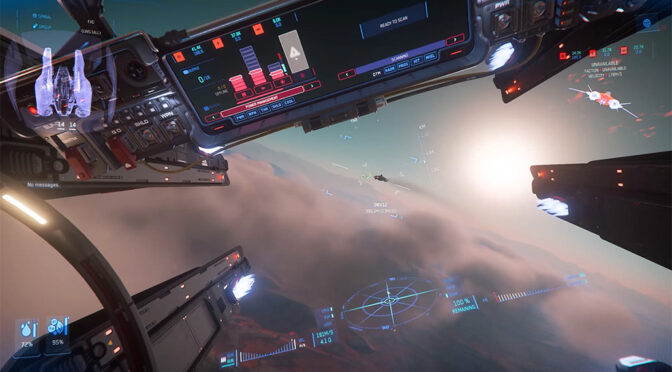
It’s not every day that you get to meet a video gaming legend. The journey from Wing Commander to Star Citizen has been a turbulent one for Chris Roberts, but one where he is, ultimately, likely to prevail.

Star Citizen is a record-breaking crowd-funded space game developed by Roberts’ Cloud Imperium Games that places the player in a living sci-fi universe. But this is no ordinary video game. In development since 2010, backers have been treated to a slow drip of playable modules, with the game effectively entering early access in late 2017.
The long development cycle, which also includes the yet?to?be?released standalone solo campaign Squadron 42, has given rise to a huge community fanbase. And it’s at one of those fan events, Atmo Esports’ Enter Atmosphere 2956 at Fortress Sydney, that I caught up with Chris Roberts. We chatted about his space opus, discussing where it came from, where it is right now and what we’ve got to look forward to in the future.

Hello Chris, thanks for taking the time out to talk to to me. Now, Star Citizen has one of the most ambitious scopes in gaming history. What originally convinced you that this level of scale was achievable?
Chris Robert: When we first started Star Citizen, we weren’t intending for it to be as big and all-encompassing. The idea was to do something more in line with the way Freelancer or Privateer had been. It wasn’t like it is right now, where everything is at one scale, it’s all first person, and you get into your ship and inside is fully realised, all the planets are fully realised, and you can fully circumnavigate them. Every blade of grass, every inch of the planet is there. There’s no fake area that you can’t go to.

Originally, I wasn’t thinking along those lines, and we figured we’d probably need about 20 million to do a sort of next-generation online version of Freelancer. But there was such a great response, and so many people backed us.
The original idea with crowdfunding was to validate the demand, because at the time, everyone was like “PC’s dead, only console games matter” and space games – everyone was saying they’re dead. I’d gone away from making games, and for whatever reason, space games had stopped happening. But I liked space games, and I like playing on a PC – I thought there had to be other people like me who liked the same thing. So that was really the theory, the same people who liked playing Wing Commander were still around and were still playing Freelancer, so let’s see what happens.
I had some investors that were lined up to back Star Citizen’s development, but then, when the crowdfunding kicked off so well, Sandi (Roberts) was like, “Oh, you’re not going to need the investment. I promise you it’s going to raise at least 20 million by the end of this year.” I’m like, “You’re crazy”. Well, you know, I’m glad she was crazy.
So, how did the development of the game go from there?
Chris: So, then we had a couple of fortuitous moments. I’d picked CryEngine to start building on, but Crytek were having some difficulties at the time and almost went out of business. A lot of the core Crytek team were looking for somewhere else to go. They were talking to Epic, and they also came and talked to us. We told them that we’d rather they stay and help shepherd and customise the technology for us. So, with that, we were lucky enough to start our German office, which was the core of our engine development.

And then, Marco Corbetta, who is one of the original architects of CryEngine, tells me that he’s working on creating procedural planets. He showed me some pretty awesome stuff. So, we went to the community and asked them if they would prefer that we stick to the smaller things we originally planned, or if they would rather that we go for it and add all these extra features, like procedural planets and a bunch of other stuff? And the community basically said they wanted us to go for the bigger scope. And so, we went for it.
With that increased scope and the funding to do it, we could really invest and go from a more modest vision to building the game that I’ve always wanted to make. It was as if you asked me, “You’ve got infinite money, infinite time, infinite resources – what would you do?” That’s basically what we’re building with Star Citizen.
How would you describe Star Citizen now?
Chris: It’s a shared connected universe that everybody can play in, at that level of detail, with large concurrency, and you can do whatever you want. It’s like a big sandbox. So, it’s not just, “oh, I’m a space fighter,” or “I’m a pirate,” or something. You can do all those things, but if you just want to adventure around or mine rocks or be a farmer or anything, you should be able to do that.

In Star Citizen, everything is built, unlike Privateer or Freelancer, where if there was a planet, there would be just one landing section. You’d go to land, get a cut scene and have a little limited area to interact with. Now we’ve got to build a whole planet and make sure it is populated with NPCs (non-player characters), with various locations and biomes. So, it upped the challenge of having a gaming system and the engine that can handle all that.
We debuted server meshing at the beginning of last year, which has allowed us to really increase the number of people who are online concurrently. And that will further increase this year, because we’re going to have dynamic server meshing. Right now, we have a fixed array of servers that we assign different territories to take care of in the overall star systems that we have.
With dynamic server meshing, the idea is that it is always checking how many people it’s dealing with, and it’ll spin up an extra one if it needs some more processing power. If a lot of people go to one area, it’ll spin up a couple of extra servers to handle it, and then if they’re leaving the area, they’ll go down. The problem with the static meshing is that you are fixed; you have that server looking after that area, whether there’s one person or 500 people there. It’s been fun, and I feel very lucky because the community has been really passionate.
The Star Citizen community is famously passionate. How does that intensity shape development decisions?
Chris: It’s really interesting because it’s very different from the way I used to make games in the past. Where you did it away from everyone, and then you can say here I’ve built. But I think for something like Star Citizen, where you’re building this universe for everybody to play in. It’s really, actually quite good having the community we have that are playing it, giving the feedback. Sometimes people can be a bit rude online, but it doesn’t matter; it’s like being a sports team, you just read all the criticism – “That was stupid. I could have scored that goal,” or whatever.

But you get genuine feedback, and it’s actually quite an interesting thing for me, and also everyone who’s developing it, because you sort of see it. How nice it is to have the one-to-one feedback. If you talk to an actor, they’ll say they like theatre because they can perform in front of their audience, and they get that connection. And I think that, in some ways, the open development that we’re doing is a little bit like that, because you’re delivering features and stuff, and you get instant feedback as opposed to when you work on it for five or six years before you release it. And, in some ways, I think the passion and what the community also helps shape the game.
How important do you think the out-of-game lore and fan events, such as Enter Atmosphere, are to Star Citizen?
Chris: Where we are here right now, this is a great example. Because we didn’t necessarily say we’re going to do racing in the game. But people at the very beginning started to go, “we could race,” and so players used to set it up. It was all user-done. Someone would be like, “Okay, I’ll be at the end point, you’ll be at the front point, we’ll time it, and you’ve got to go here and here”. And so, it just organically grew out of groups of people racing. We’ve added tools and things into the game to support racing.
The community group running this Enter Atmosphere 2956 event, Atmo Esports, created the Daymar Rally, which is a really cool Dakar Rally-style race that they do once a year. I think it’s about six or eight hours long. You start on one part of Daymar, which is this desert-like moon planet. They have whole teams that support the people racing, so it’s not just the person driving. They’ve got people doing the camera work and they’ve got people doing security, in case a griefer tries to come in and get in the way or stop the thing.

And it’s awesome, and that is all because of the sandbox nature of the game. I have always been really surprised and fascinated by a lot of the things that people do. Just because you want to be a hotshot pilot, you think everyone just wants to do combat, but no, there are plenty of people who are not at all interested in combat; they’re interested in trading goods or doing some mining, or doing something totally different, like search and rescue. You get stranded on the planet, and they’ll come and get you. And it’s great.
It’s just really interesting because you’ve got all these different groups that are very focused on different things. I was watching a video by a streamer called Dtox. His group had an Aegis Idris, and they were doing these carrier operations with the Idris, which was really cool. So that all that stuff, for me, is fun. It’s like you’ve created this playground and you get to see and who plays with it.
Looking ahead, what upcoming systems or milestones do you believe will fundamentally change how players experience the game?
Chris: Well, we’ve got a couple of things this year. We’ve got crafting, which we are going to release the first version of in March, and then there’ll be the more fully-fledged version that will come with a patch afterwards. I think that’s going to actually be a pretty big thing, because right now, you can go out and you can collect resources, you can mine, you can salvage, you can go and look for rare rocks and stuff like that. But at the moment, you just do that, and then you sell the stuff. Whereas with crafting, it allows you to get materials, and then the materials have a quality amount. So, you’re not always going to find the purest quality stuff. But when you do the purest quality, whatever it would be, tungsten or something, when crafting with that, it allows you to make something better than a stock item.

I’m pretty confident that’ll make a whole new game loop. There are other games that are quite popular where people craft better equipment and then sell it to other players or use it themselves. So that, I think, is going to be a pretty big shift for Star Citizen. Right now, if you buy an FPS weapon or a gun for your ship or something, or an engine, or a thruster, it’s all pretty standard and stock; you can’t tweak it or tune it. Crafting is the way you can make better equipment, so your ship or yourself in FPS will perform better.
I can definitely see there’ll be people who will make it their profession, where they’ll just go find stuff, or maybe they’ll just craft and sell to other players. And there will be other players who will just be collecting the resources for the crafters to make that stuff. So that’s going to be a big thing.
That’s going to be massive. What else can we look forward to?
Chris: We’ve also got base building, which is the other thing that’s really going to make a difference. Base building is really like the ultimate version of crafting because, again, you’ve got to collect resources to build your home or whatever. But it’s not like World of Warcraft, which has just introduced player housing, where you go to a neighbourhood, and that’s where you put your house. With Star Citizen, it’s like anywhere you want to go, any planet you want. We’ve got such a large amount of real estate, because we’re fully simulating and rendering all the planets and the moons.
So, you could find somewhere and settle there?
Chris: Yes, this could be your ultimate dream, where you could go and find a place on a planet, and say, “I love this view. This is going to be where I’m going to put down my roots.” I think that it will allow people to really build their home in space.
Right now, you’ve got your hanger, where you’ve got your ships, and there’s a hab unit that’s close to it. But you don’t have that sense of adventuring in space, of finding a place, maybe close to some resources that you can mine and build your own home.

This is, in some ways, the promise of the dream of science fiction. To go out and conquer new frontiers. So, those are two things I’m really quite excited by.
We’re also doing dynamic server meshing, as I mentioned, that will come online this year. That will allow us to have more people concurrently in the same space all the time, which will help the world feel alive. We used to have it where we had 40 people, then it was 50 people, then it was 100 people, and then we went to server meshing, where we can do 700 or 800 people in a space now. So that makes a difference, because like if you just hang out, say in a space station, you’ll see ships coming and going, there’ll be other players, which is kind of cool.
I was doing that the other night. I hadn’t been back on Star Citizen for a while, and it was nice to just watch people going about their business.
Chris: We’ve got something in our Austin office, and I actually want to do this on our website, where we have the equivalent of city cams or traffic cams. You can just look around like they do in Abbey Road in London. In Austin, the IT team just have some cameras that rotate around various parts of the ‘verse. You can just see what’s happening in the virtual universe right now.
You’ve now embraced virtual reality in the game, which I’ve not had a chance to try yet. How important do you think VR will be going forward?
Chris: It gives you a sense of scale, and that’s one thing that Star Citizen does really well. Because you are on foot, and the ships are fully realised inside, you can walk around and get a sense of the scale. You can look closely and see all the details on the little nuts and bolts, and how the ships are put together. So, I think everyone who plays it in VR gets that feeling of scale. We released the experimental mode this Christmas, and that was the number one feedback: that you have a sense of immersion and scale in a way that you don’t get on a flat 2D screen. So, you can look around and see stuff
The fact that you’re actually walking into the ship means that there’s no sudden blank screen. That’s what I’m looking forward to.
Chris: I think if you like VR, you will be pleasantly surprised. We’ve got some people who can’t go back to playing on a flat screen because they feel so completely immersed in the world playing in VR.

We are also going to have VR play in Squadron 42. That’s pretty cool. Because you’re in there and it’s, “look, that’s Gillian Anderson”, but she’s there in front of you, instead of on the screen. It’s a weird feeling, but it’s cool.
That is going to be cool. We could probably talk about Squadron 42 for hours. I’m not going to do that, but I am excited about it. Are you excited for it?
Chris: I’m very excited for it. In the way that Star Citizen is the dream space sci-fi sandbox I’ve always wanted to build. Squadron 42 is the same for me, making a Wing Commander. I’m basically making a Wing Commander with all the tools and toys that I’ve got now, with resources that I probably would not have been able to get if I were doing it for EA or whoever.

In terms of the immersive story that you’re going to be playing through, being a hotshot pilot in this science fiction universe, it’s great, and it’s my love letter to all the movies I loved in the 80s and 90s. So, I think yeah, if you like all those things, I think you’ll like it.
My original inspiration for Wing Commander was a combination of Top Gun, World War II movies and Star Wars – all those things mashed together. Squadron 42 is 100% a big love letter to all that. I’m quite excited to have people experience it, which hopefully won’t be too long from now. So yeah, we’re in the final stages, which is great.
One last question, if you could communicate one message for newcomers to Star Citizen, what would it be?
Chris: I think it’s a welcoming universe; it’s a place to come, play, and meet people. A place to make friends and live life the way you want to in this science fiction universe. And it’s open to all. There’s not meant to be a winner. It’s not meant to be, this person’s the best,” or this person is number one, or anything. It’s literally a blank canvas for you to live your imagined life in this future science fiction world and meet other people while you’re doing it, as well as have a great time. That’s how I see it. I feel like it’s a great playground for all fellow sci-fi nerds and nuts that like to imagine themselves on a distant planet somewhere.
That’s fantastic. Excellent. I really appreciate the opportunity to chat with you today, Chris.

To see such a gaming luminary as Chris Roberts, almost giddy with joy over the effort that Atmo Esports put into the Enter Atmosphere 2956 event in Sydney’s Fortress gaming venue, was something else. Star Citizen has been in development for a long time, it’s had its detractors over the years, but I was able to see first-hand the fruits of Chris Roberts’ tenacity, of what happens when you are allowed to build a game with an uncompromising vision. With the persistent multiplayer universe of Star Citizen available to play right now and the solo campaign Squadron 42’s imminent arrival, there’s never been a better time to venture out into the ‘Verse.